
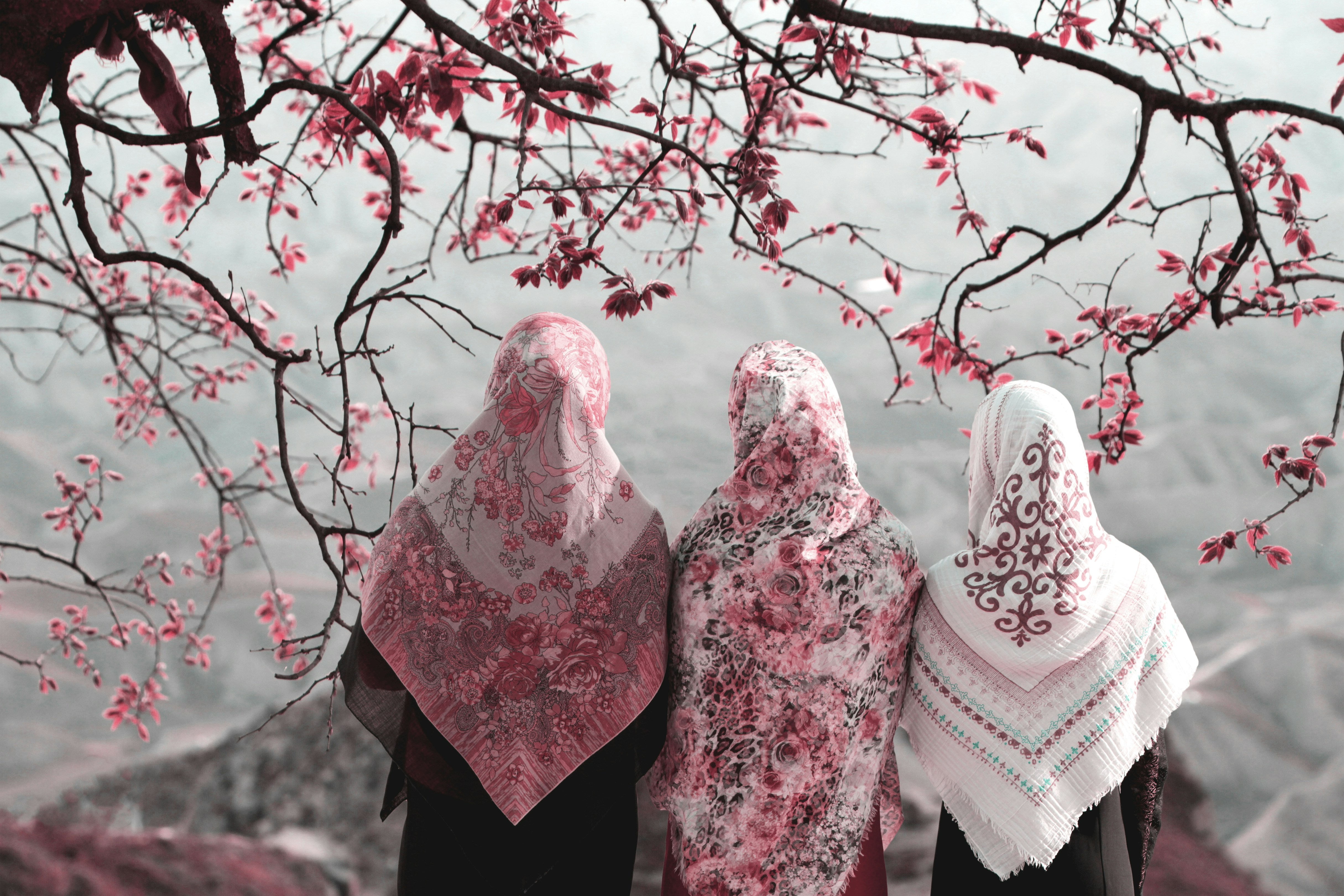
This is a variation of a talk I have given for years to young Muslim women & teenage girls on the issue of the hijab after I teach the fiqh rulings of it.
Let’s get the basic fiqh out of the way. It is a fardh ayn (individual obligation) on a Muslim woman to cover all of her body except her face and hands (and except the feet for the Hanafi school of legal thought) in the presence of unrelated members of the opposite gender excepting her husband.
This therefore entails that it is also obligatory to cover the hair and neck (i.e. anything other than the face). This is what we call colloquially today call the hijab, although the Qur’anic term for this is the khimar, and in the Islamic legal tradition this ruling comes under chapter sections on satr-ul-awrah or ‘concealing nakedness’.
This is a ruling of obligation which means that a Muslim woman who does not do this is sinful and must sincerely repent for not doing so, and is at risk of committing the major sin of tabarruj, i.e. showing her beauty in public.
This obligation is agreed upon by the consensus of Islamic scholars since the time of the Prophet SAW as the only authoritative legal interpretation of the verses in the Qur’an & prophetic Hadith on the issue of a woman’s clothing in public. The consensus on this issue is so watertight that anyone who believes otherwise is either:
A) At best adapting an impermissible innovation into their beliefs and separating themselves from the Muslim community & it’s normative beliefs – and thus at risk of being isolated from the Muslim community at the hawd or pool of the Prophet SAW on the Last Day.
B) OR, at worst this is so fundamentally opposed to the basic beliefs of Islam that not believing it means they do not believe in Islam i.e. it is kufr. They believe in something else that is not-Islam. They must abandon this belief if they held it sincerely and may have to renew their shahadah if they adapted this belief antagonistically to the consensus of Islamic shcolarship (i.e. not out of confusion or mistake etc).
As for the issue of wearing a face-veil, this is also a normative feature of Sunni Islamic Law across the four fiqh schools, although scholars differed on whether it is mandatory or recommended to wear it. The niqab is not the primary focus of this article though.
Now that we have the basic fiqh out of the way, let us move on to what this article is actually about.
Is The Hijab Essential?
This is usually the question I ask after first presenting the above fiqh to my female students. Why do I ask it?
When I was studying fiqh with my teachers, it was quite striking how much of a difference in emphasis there was between the issue of hijab in the books of Islamic law, theology, spirituality, tafsir & hadith, and how much emphasis is placed on the hijab in Muslim politics & society.
In a massive encyclopedic work of Islamic law that is 20-30 volumes large, the ruling of covering women’s nakedness takes up barely a few paragraphs or a few pages at most. The rest of the work is about purification, prayer, fasting, pilgrimage, transactions, marriage/divorce etc. So why do male & female Muslim preachers, influencers and religious personalities keep bringing up & discussing the hijab repeatedly despite this disparity?
The simple answer is: it’s more because of the status of hijab in society and politics over the past century, NOT because of it’s status in Islam.
Why is this a problem? Because the politics & social aspects of hijab end up obfuscating a lot of what most Muslim women really need in their spiritual foundations & progression – the vast majority of which is nearly identical to that of males.
The hijab for the Muslim woman has become THE symbol for her ‘religiousness’, as if it is essential for her salvation in the afterlife – but this is not the status of the hijab in sacred text or the Islamic tradition.
What leads to this are the extreme reactions of either thinking of hijab and conservative clothing in general as the end-all-be-all (i.e. essential) of being a Muslim woman OR discarding it entirely in exasperation as to why an article of clothing or the act of dressing a certain way should define a Muslim woman’s spirituality. Both approaches are a result of the politicization of the hijab.
As we mentioned above, it is indisputably obligatory for a Muslim woman to wear a hijab properly and she is sinful for not covering herself with it, BUT is it essential to her faith & what the majority of her religious & spiritual focus should be on? Simply: No.
The Politicization of the Hijab
The academic & popular analyses of this topic & its controversies are copious & widely available, so I’ll be sparse on the details here and stay on trajectory as much as possible.
The hijab is one of the most visible & striking public symbols of Islamic religious ritual, especially in an era where the appearance, public role & clothing of women have become key political issues in both local & international politics.
Ever since the issue of women’s clothing became entangled with the issue of personal & communal liberty in the early 1900s in the West, it has been consistent topic of discussion in the Western social & political arena.
As is par for the course of European & Western colonialism, the West came to see its values & discussions on women’s clothing as inherently relevant & prescriptive for all of humanity, not just for their own cultures or civilization, even if their values & principles were unique to their cultural, ethical and political history. When the British & French violently colonized the Muslim world for its economic resources, they utilized the issue of women’s clothing (among many others) to justify their subjugation of the ‘savage’ and ‘backwards’ peoples of the Muslim world.
Thus, at first, the hijab became one of the symbols of resistance to British & French colonial pressures in the 1900s. As these colonial powers lost control of these Muslim territories, this symbolism continued. Secular ‘Muslim’ government & leaders inspired by a post-colonial inferiority complex, Cold-War era allegiances, American political, military or economic force and plain old nifaq also took up the mantle of politicizing Muslim women’s clothing as they tried to build up modern Muslim states with an underlying Muslim religious character.
To quote a few examples, modern Muslim states like Turkey outright banned the hijab as being contrary to the values of the secular Turkish state. The Egyptian post-revolutionary leader Gamal Abdel Nasser openly mocked a proposal to enforce a women’s social dress code inspired by Islamic ethics. Tunisia eventually banned the hijab in the mid-1990s. To this day, many Muslim & non-Muslim countries have either banned the hijab or more widely, the niqab or face-veil worn by some Muslim women (which is an established Sunnah in Islamic Law, but not part of the discussion in this article).
Due to these secular, authoritarian anti-hijab attitudes & policies of both Muslim & non-Muslim states in the 1900s, there was a counter-reaction to promote the wearing of the hijab as not just a religious obligation but as an act essential to being a Muslim woman. Scholars wrote books and preachers recorded entire audio & video series on the hijab. Countless khutbahs & reminders have given by Imams across the Muslim world on the importance of wearing the hijab for the Muslim woman. They continue to this day.
I grew up in Riyadh, Saudi Arabia, surrounded by women wearing full black abayas and full niqab. I then lived there again after university when I was studying Islam, and witnessed how Saudi society’s views on hijab in the country began to wither away in society and how local scholars and preachers reacted to this. Many of them have still not realized how their constant preaching about the importance of hijab didn’t save the faith of the current generation of many young Saudi women.
The reaction was especially acute in the case of movements that saw themselves as counter-movements to the excesses of Western modernism. In Deobandi & Salafi communities, for example, wearing a niqab became not just a religious obligation, but as an act of rebellion towards a totalizing secular world order in which a woman’s appearance in public became politicized, it became an essential demonstration to God (and the public) of one’s piety.
Now today in the West, especially after 9/11, the hijab has taken on another political role: of struggle against institutionalized Islamophobia and discrimination against Muslim women. Combine this also with the continued dehumanization and defeminization of the Muslim woman in foreign policy (i.e. the new colonialism) whether in Iraq, Iran, Afghanistan, Kashmir, Xinjiang, Palestine, Yemen or otherwise
More than ever, the hijab is seen as essential to a woman’s faith by the public, preached as such on the minbar, and emphasized as such by the scholar. It is to the point that the hijab is now an social identifier where the word ‘hijabi’ is used as a normative typifying category for Muslim women. The identity of ‘hijabi Muslim woman’ is juxtaposed with that of ‘Muslim woman’ and contested in Hollywood, social media, popular Muslim culture and inter-Muslim politics. Female Muslim figures, especially political & religious ones, are celebrated primarily because of their head covering, not their values, level of Islamic knowledge, character or overall ritual observation.
It is important to understand that both the secular attack on the Islamic ethics of women’s dress and its counter-reaction that led to an over-emphasis on hijab are both artifacts of Western modernism coming into contact with the Muslim consciousness, not just the first!
All of this, as I will now argue, is very problematic. This essentialization of the Muslim woman’s faith to the hijab – due to political history, not something inherent in the Shariah itself – has caused serious confusion in the understanding of what it means to be a righteous female believer in Islam, and is leading young Muslim women themselves astray in how they think of themselves, Allah, Islam, spirituality, religious practice. Muslim scholarship, and of course the hijab itself.
The level of dysfunction in this the popular conception of hijab is so great, that we now have a phenomenon of homosexual & transsexual ‘hijabis’, tattoo artist ‘hijabis’ and even manifestation & astrology ‘hijabis’ on social media being celebrated for their ‘hijab’. It is obvious that there is something deeply broken in society on this issue.
The Hijab & the Muslim Woman’s Relationship with Allah
By this point some readers may be confused… what is the point of this article? Let me give some background.
As a high school teacher in Islamic Studies for 7 years where half of my students were always girls, and a father of 3 girls myself, I’ve had to figure out how to build the mind and heart of a young Muslim woman. Being a father of Muslim girls in this time, especially in the West, is terrifying. So strategy and planning are required that are according to the Islamic tradition while still being effective in the current environment.
What I realized in the process of helping young Muslim girls and women to develop intellectually & spiritually in their Islam, is that hijab is not an issue you start with, especially in the West. There will be a minority of girls and young Muslim women for whom it is easier to do the hijab together with other mandatory acts, and they should be encouraged to continue. In many cases however, forcing teenage girls to wear hijab can be a huge mistake. The politics of the ‘hijab’ is too totalizing to be careless about.
Most Muslim women (just like Muslim men) are just too deficient in their Islamic knowledge & overall spiritual condition for reminders or exhortations about the hijab to be relevant to them. In fact, khutbahs, social media content, lectures and articles about hijab are often a distraction for these women from their immediate religious and spiritual needs.
What most Muslim women need is not too different from what most Muslim men need for their faith. They need to learn the basics of their religion, detach their hearts from obsession with the material world, start praying their five daily prayers and stop committing major sins – of which not wearing hijab is just one.
It is not uncommon to see Muslim woman who wear hijab but have incredibly incorrect and problematic understandings & practices of the basics of their religion.
Examples of these include the many doubts in faith that are specific to Muslim women. Much of what we discuss in classical Sunni philosophical theology (Kalam) e.g. cosmology, contingency etc is simply not relevant to the faith challenges of young Muslim women. An example of a major reprehensible innovation in religion that many young Muslim women fall into is considering male scholars of Islam to be dismissed as authorities because they are part of the ‘patriarchy’. Another is dismissing interpretations of certain verses and hadith that have been scholarly consensus for over 1400 years of Islamic history.
Many ‘hijabis’ can be committing major sins like missing prayers constantly, zina (unfortunately it is not uncommon to see some with boyfriends in universities), not taking rulings on menstruation seriously and thus not making up fasts on time or not praying etc etc.
There are also many spiritual errors I’ve seen such women fall into, such as arrogance towards the Qur’an & Sunnah or other people, poor adab & akhlaq, an obsession with dunya & entertainment, and their faith being conceived of in a political sense – e.g. being a Muslim woman is an act of rebellion towards society rather than an act of submission to the Creator.
I have seen all of these examples first hand. These are not theoretical. But am I being unfair here? I don’t think so.
What makes these cases different from the average Muslim doing the same thing, is that many times these women – and others around them – believe that they are still ‘righteous’ or ‘religious’ Muslim women just because they are wearing hijab! Non-Muslims who see the hijab as an outward sign of immense piety and praise or criticize it only reinforce this false sense of security.
What many of these women need as an immediate priority is NOT hijab. The religious & spiritual priorities are wrong. PLEASE NOTE: I am not saying these women should take it off! What I am saying is that basic Islamic intellectual & spiritual development that should have preceded the wearing of & emphasis on hijab is missing! Whenever I see and hear the Muslim woman essentialized to the hijab in khutbahs and talks in mosques I get angry now, because I know that the girls in the congregation are still being distracted from what they really need. To exemplify, I have been in khutbahs where reminders for prayers and the Qur’an are given to the men, but only hijab for the women. This is disastrous.
What many of these young girls & women need – like most Muslims today – is a true connection with their Creator by first learning their Fardh A’yn Islamic knowledge, obeying Allah & His Messenger SAW in the core obligations and avoiding major sins, purifying their heart of spiritual illnesses, being attached to the Qur’an & Hadith, keeping the company of righteous women, and getting off their phones/social media. Wearing the hijab in all this is just one action that a Muslim woman is indeed sinful for not doing – but not at the top of the list of priorities. A lot comes before it.
What will ultimately matter when the angel of death comes to take the soul of the Muslim woman: whether she wore the hijab, or her overall relationship with her Creator?
Final Thoughts
Why did I write this? There are varying articulations of what I have written here already published everywhere. I think about issues to do with Islam & women a lot because of my daughters and many female students. I have found this discourse to be useful and helpful to them, and hence me sharing it here. May it benefit those who have not been exposed to it otherwise.
I know it’s a struggle to wear the hijab today. I know that Muslim women carry a huge burden on their shoulders by wearing the hijab and being visibly Muslim in a way that Muslim men can easily avoid. Nothing I wrote here was meant to challenge the courage of Muslim women or the perspicacity they are forced to develop to negotiate their very public faith identity in society.
However, we cannot let sympathy distract from the issue at hand. Facts are facts. Covering one’s awrah is just one act of obedience to Allah. It is a major one for Muslim women given the serious sin of tabarruj, but it has become so politically loaded that it’s original context in the Shariah is almost completely lost among many young Muslim women.
My goal in this article was not to make hijab-wearing Muslim woman feel humble, nor to make the Muslim woman struggling with hijab feel better (even if that does happen). Rather it is to raise & correct a major, critical concern about the understanding, attitude, thought & practise among many young Muslims today.
And Allah knows best.




Leave a Reply